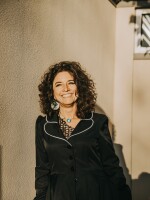
Liz Lerman, dancer, choreographer, MacArthur and Guggenheim fellow and writer, will deliver a free public lecture Thursday evening at the Faulkner Performing Arts Center on the University of Arkansas campus. The talk, "Shape and Momentum: How We Work, Communicate and Plan for an Uncertain Future," draws on Heisenberg's uncertainty principle and her forthcoming book of the same name. Lerman is also the creator of the Critical Response Process, a feedback framework designed to leave makers eager to return to work. This academic year, she has been working closely with the UA School of Art on a strategic framework. Last week, Liz Lerman joined Kyle Kellams, Rachel Debuque, director of the School of Art, and Lia Uribe, associate dean for arts and humanities in the Fulbright College, for a conversation that touched on creativity, physics, bowling, optimism and uncertainty.
Lerman: I know much of our life we are rehearsing for something, we are planning for something that's coming up. But I'm also advocating that we're in our life while we're planning our life. And so how we take time to be with each other — what are the conditions we establish so that, OK, I'm in a planning meeting or I'm in a rehearsal or I'm trying to think about my future — what am I doing in this moment that brings me strength, maybe kindness, maybe support, maybe risk? And that we understand that it's in the moment as well as what we're doing. So that's one thing to think about, especially when I'm with young people. But honestly, at my age, it's the same thing — different kind of uncertainty into the future, but definitely big questions. I would say one more thing about this, which is this book that I've written that's coming out in the spring is about uncertainty and takes its title from Heisenberg's uncertainty principle. This is my version of it. So for any physicists listening, I'm sorry, I'm probably not doing it full justice. But the idea is if you measure or see the shape of something, you cannot feel its momentum. You can't see the velocity because you're dealing with the shape. But if you're in motion, it's hard to feel velocity. It's as if you're either a shape person or a movement person. Institutions hold on to their shape. They don't want to change and move into velocity. I'm advocating that both are critical and that our capacity to understand that we need shape — we need to be able to see the thing we're in together — but we also have to be able to let go, go into that place where you're not exactly sure how you're going to land or exactly what's going to happen. That's critical too, and creativity gets us in both those places.
Uribe: Liz, I'm super excited to have you here. As associate dean of arts and humanities, this is important to me that my unit and faculty and students are also able to put together all of your experiences and ideas in their daily life. And of course, this is an invitation to all community and all students and everyone. But I find that this is a special moment in which we as artists and humanists have a special role in how the future will be defined. With the rise of AI and technology, we are needed behind those technologies. We as artists — as you were talking about creativity, imagination — we are the ones that are able to, without so much limit, imagine a better world and start working toward that. I wonder if you can tell us more about how all that you have done, that started specifically in dance and choreography, can be transmitted into our artists and humanists. And what is the message for our community that you will bring?
Lerman: Well, for me personally, having been first a dancer and then a choreographer, I feel particularly lucky that I was able to be in worlds where, first of all, our bodies are engaged — and how incredibly important we need to be aware of that, especially with so much screen time. And the more we relinquish certain aspects of our being, to have lived a life that was so full of being together. The other thing in dance is that dance is such an individual thing. You stand alone at the ballet bar, you are working your own body, but it's also very communal and very collective, and you are engaged almost always in ensemble work. So the relationship between when we need our own independent — we need ideas. I find, for example, with my students, I teach at Arizona State University, and my students, who I adore, have grown up working together in collaboration. And sometimes it's hard for them to be singular. I have to really help them remember their own ideas matter, and to give agency and to have agency, which is really important. But also then the times that we spend together. I think right now, aspects of our creative life as artists and humanities people is in part our reliance on, or our willingness to accept, our wild imaginations. I think for a lot of people, creativity is sort of like it comes unbidden — they're happy if it arrives. But I really believe just because it's naturally occurring, we can also nurture it. And what arts and humanities do right now, and why I think it's so critical in higher education, is that we want people to nourish their birthright, which is to be a creative human being. Which does mean to have imagination, which is about creating worlds — maybe first in your own imagination that don't exist but that could — maybe seeing a problem and understanding there are multiple ways to answer that problem and not being afraid to put your own idea forward, even if the group speak is in a different direction. These are things that you have to practice. And what's wonderful in most curriculums in art and humanities is the opportunity to practice that. It's also true in engineering — it can be true in many fields. But sometimes people go for that first answer and they go really fast. And it's helpful to sort of dwell in the mess.
Debuque: What you were talking about with shape and momentum — Liz is assisting the School of Art with our strategic framework. She came in to help us build connection and relationship with a faculty retreat, and then that blossomed into her leading our strategic framework. And we talked a lot about this idea of shape and momentum, and also how do we focus on nourishing that creativity within our students, within our faculty, within our staff? How do we give things enough shape that we don't choke out the creativity in our own systems and practices within the school? It's been a really amazing process and a delicate balance. And I think for me, Liz has always taught me throughout my career that toeing the line between those two things and how important that is — and to not lose sight of one or the other. So Liz has been so pivotal in my journey as an artist and as a leader, and this has really been a full-circle moment to have Liz engaging with Fulbright College and the School of Art. I feel so much gratitude.
Kellams: What I love — and it is a public lecture we're talking about — is while this can apply if you're going to be on stage or working with someone on stage, what you're talking about applies to everything, really.
Lerman: Yes, it does. And sometimes I think we accord artists some freedoms that we should all have. And if only we understood that — the artist in each one of us, if that's language that helps. Or if the language is more like: all the people I know are creative, where in their lives are they creative? But somehow we've let artists sort of have that place. And I don't think it's only artists at all. It's in every aspect of our life. And one of the things I work with is called the Critical Response Process, which is the system for giving and receiving feedback. Yes, it's true — it grew out of my own frustration with the way critique was handled in my very tiny niche of the dance world in the United States at the turn of the century. That's a tiny little world. But its success — or maybe the fact that it's in use in so many different parts of the world and in different mediums, in business and science — helped me understand exactly what you just said: that it belongs to all of us and is applicable everywhere.
Debuque: I really think of Liz as a life coach. These ideas are so applicable in so many different ways. And for us, it's been really incredible thinking about the School of Art really wanting to propel forward access. And the way that Liz thinks — having come to it through dance, but expanding it out into all of these reaches — speaks to the power of creativity and creative thinking. And I think this lecture is really going to be applicable to all different disciplines, which is what I love.
Kellams: Earlier in the conversation, we were talking about Heisenberg and the uncertainty principle. It makes me think, especially for someone who grew up in rural Arkansas and didn't have any access to dance or to physics — they're both these sorts of disciplines that when you are exposed to them, you go, "Oh." And while we talk a lot about planning, the role of surprise in life and creativity can just be so wonderful, don't you think?
Lerman: Oh, I totally think so. And I'm noticing in this conversation how much we're talking about how you need to hold at least two ideas in your head, at least two ways of being. Train, train, train — but wait, be available to the way that tree just moved, or the way the wind — and you go, wait a minute, I never moved like that before. But you're raising something I think really deep. The one person who articulated it for me was Charles Darwin. I was doing some work around him when I was working with the scientific community, and a book that really meant a lot to me was "Darwin and His Daughter." It's about his incredible way he educated his children, and then she dies young, and then he is bereft, and the book poses why that might have taken him so long to publish. But what comes up in the book is: while he's teaching his children, they take walks, they go everywhere. He says, observe with and without reason. So you see, "I am going looking for something, I need to find this particular thing." But then: "Wait a minute, observe without reason — anything could happen." And so we can see, holding what you just said, the idea of surprise, the incredible randomness of it all on the one hand, or our capacity to create meaning on the other — and purpose, and faith, for some people. And in my world, I want to live in a world where I can have both. I want my embrace to be so large that when I need faith, I can have it. And when I take the risk of surprise, or it's flung upon me and I have no choice, I can have that too. And I think a lot of the work in this book, and a lot of my work over time, has been helping people figure that out. Sometimes I say it's like you have two sit bones, but it feels like one. We have two of a lot of things, but they often feel like one. And just getting people to see that you have choice — and I'm back to shape and momentum now — that it's OK to need shape. When my mother was dying, I needed shape. I was back to classical ballet. Don't make me improvise. Just let me have classical ballet so I know exactly where I am. But at other times in my life, I pushed off against classicism so much because I wanted a different kind of freedom. And that's the kind of thing I'm talking about.
Uribe: Continuing this into one more deep emotion that I think we share at times these days of uncertainty — fear. What is the role of fear in all of this?
Lerman: Fear. This is a little bit strange, but I have spent — I am obsessive about organizing what I call creative tools. And I started doing this when I was very, very young, and it was very antithetical to my generation of artists. We were told to be mysterious, to never — to keep it obscure. It was all just kind of going to happen. And meanwhile I was busy trying to figure out: why did this work this time? How come it didn't work the next time? Let me try this with a group of old people. Let me try it now in the hospital where I work with the kids. And I've seen that these tools are amazing — they support me when I'm in freefall. And the reason they support me — and in fact why I might even desire freefall — is because when I'm in freefall, I have the chance of finding new tools, because all the while I'm falling, none of the old ones work. And so you are thrust into a situation where you actually have to invent. And that's amazing. So in some ways, the counter to fear is the ability to access the knowledge you already have — the things you already know — and not to dismiss it. We are so quick to dismiss what we know, or we don't even know we know it. So on the one hand, knowing that you have those capacities — that's a way to counter fear. Now, I don't even think we're in momentum right now. I think we're in chaos. And chaos is a little bit different than momentum, because in momentum you can still have control — like I know how to fall, so I'll be OK. But in chaos, you don't know when you're going to fall. You don't know what's going to knock you over. You don't know what's coming. You have no control over that. And so even the best of your skills may not work. So I'm very interested in that. And interestingly enough, I turn back to physics again and started looking at other times when we were in chaos. And of course, the Big Bang is the most obvious one. And what did it take? I mean, we couldn't even have oxygen. We had nothing in the Big Bang. And what happened to finally make these things connect and stay together? And my advocacy these days is that one answer to the fear is to connect. Try not to be alone all the time. Connect. And it doesn't matter if it's just a walk, a trip to the grocery store. Talk to — I talked to all the cashiers all the time now. Poor people. I mean, I just, you know, they're standing there. Just keep connecting. It feels to me the most basic level. But I think when we think about fear, a lot of that's about control — sorting out where we do and don't have it, and where we can have it, and what to do with what we have.
Kellams: What about optimism? How important is that?
Lerman: Well, I am luckily the child of one of the most amazing optimists in the world. So I often say jokingly, I take my Philip E. Lerman anti-bitter pill every night — because my father had every reason to be bitter. The way his life worked out, and all the kinds of stuff he had to deal with. Actually, his mother died when he was 6 months old in the flu epidemic. So just start with that. But he somehow — and I think his optimism was based on his conviviality. He could talk to anybody about anything for a long period of time. So I think, again, nurturing that is really powerful. And on another level, I just think of it like going bowling — luckily they pick all the pins up, right, and then you get another chance. So I always kind of think, oh, bowling — that's the way to practice optimism.
Liz Lerman will speak Thursday at 6 p.m. at the Faulkner Performing Arts Center on the University of Arkansas campus. The event is free and open to the public. The conversation also included Rachel Debuque, director of the University of Arkansas School of Art, and Lia Uribe, associate dean for arts and humanities in the Fulbright College.
Ozarks at Large transcripts are created on a rush deadline and edited for length and clarity. Copy editors utilize AI tools to review work. KUAF does not publish content created by AI. Please reach out to kuafinfo@uark.edu to report an issue. The audio version is the authoritative record of KUAF programming.