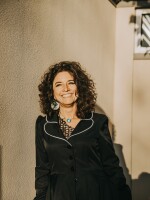
Kellams: This is Ozarks at Large with me in the Anthony and Susan Hui News Studio, Sophia Nourani.
Nourani: Hello.
Kellams: And Lia Uribe.
Uribe: Hi, everybody.
Kellams: Hello, Lia. You've been in this building several times.
Uribe: Several times. Partying, in meetings, recording, meeting new people, celebrating and sometimes recording Sound Perimeter or things related to music and Sound Perimeter.
Kellams: It may be a while before you're back.
Uribe: Probably so, Kyle. Yes. I'm leaving.
Kellams: Yes. I should point out that you'll be moving to Tucson.
Uribe: Moving to Tucson, Arizona, after 13 beautiful years in Fayetteville, Arkansas.
Nourani: Your role that you're going to be taking on at the University of Arizona is an amazing one and fits very well into what we talk about pretty often here at KUAF with you and Sound Perimeter.
Uribe: It is. I'm moving there to join the University of Arizona School of Music as their new director.
Nourani: That's exciting.
Uribe: It's a wonderful program, very well regarded in the country. Wonderful faculty, wonderful students, and a vibrant, vibrant community.
I'm excited to go back to music after being associate dean here in Fulbright College. And it brings me back to my passion of music, but also still doing administrative work that was proven to be good for me. Have more agency and more latitude to bring new ideas and new waves of change or whatever is needed.
Kellams: All right. You mentioned that you've been associate dean for the past few years, but you've stayed with music, at least for our listeners, with Sound Perimeter. How did Sound Perimeter begin?
Uribe: Oh, gosh. It was back in 2019, when Leigh Wood, who was general manager, and Katy Henriksen left KUAF. So I noticed this void in one of my favorite things, which was programs about music and people talking about music.
And by no means I wanted to replace Katy, but I, in a very selfish way, wanted to have a space in which people could relate to music in a direct way. So I reached out to Leigh and she was very trusty. She had no idea who I was, what experience I had, if this was going to be good or not. And she gave me the opportunity to start working with KUAF.
And what was the incipient Sound Perimeter, we were kind of reporting on happenings in this area, talking about events at the University of Arkansas music department and Crystal Bridges, the Momentary and anything music related, Walton Arts Center in this area. And that lasted for a while. It was really fun.
And then the pandemic hit. And then I felt again, in a very selfish way, like, what am I going to do? I cannot play bassoon. I don't have an orchestra or the Lyrique Quintette or anything, or my students.
So we talked about how we could kind of recreate that experience of music, and of course radio is the way to do it. And in reaching out to community the way KUAF does here in Northwest Arkansas and beyond, it was a perfect space.
So we started and found the name Sound Perimeter fit very well. My idea of kind of enlarging what people normally understands or embraces as classical music and maybe taking that classical music label away and expanding to all musics and labeling them. There's no one that is better or more serious or more exciting. Music is music. And that was the spirit of Sound Perimeter.
And that was back then. We are in episode, what is it, 180-something? It's been a beautiful run.
Kellams: It has been a beautiful run.
Uribe: Right. It is a beautiful run. I mean, here because of you too, Sophie and Kyle. We're going to try to continue Sound Perimeter.
It's interesting, I get all of this excitement from people that I never know. And this happens because they hear my voice at the grocery store or at the bank or whatever. And they recognize my accent and they look at me and, “Lia Uribe, Sound Perimeter.” So it's been very encouraging to know that even though we usually don't quantify who's listening, people are listening to this show and they're liking it and they are connecting.
So some of my friends were asking this weekend, is somebody gone? I'm like, no, we're going to continue. We're going to keep it.
Nourani: It's palpable, the love that people have for Sound Perimeter. I didn't start as the producer of the show. I believe Timothy Dennis was the person who kind of piloted that. It's been a constant and a highlight in my career here at KUAF to work with you, Lia, and to be able to improve my craft.
I had never worked with music in a way like I had until I worked with you. And it gave me a newfound appreciation and a newfound understanding, especially on the local level, of the people who make music here. And that has been so special for me.
Kellams: What's the value in connecting with people you don't know through music or through radio or through stories?
Uribe: The value is connecting with people, right? I mean, no matter what we do, I mean, it's been a, I'm getting emotional here. Sorry. All the tears, beautiful tears.
Uribe: Being a bassoonist, that was the fuel of my whole entire career, just being able to be there and connect with people. And then the conversation after the concert when people will come to me and tell me, I never saw bassoon before, or you're too short to play the bassoon, or that piece, whatever Latin American music I brought to people.
And it's the same with Sound. It's just, it's all about people. It's all about connections. Our connection here, I mean, the three of us grew closer together because of Sound Perimeter and many other things and initiatives that we move together. KUAF became a family. I mean, a couple weeks ago, we had here a gathering in which we all celebrated together.
So it is all about that. Those people that are listening to us, whether we know that they do or not, something is happening in their minds. Perhaps their day gets easier or lighter or happier. So that's what it is, being able to affect each other. That's how we are able to hold life together when things are difficult.
Nourani: It's also the themes and the framework that you put this music in that fits to emotion and fits what people are thinking in the moment. And it is timely in that way. And it's something that people can look forward to in their week. And it was something I really looked forward to putting together every week. It was one of the highlights. Like I said, it's one of my favorite things I got to do here.
Uribe: Thank you, Sophie. And you all were so careful putting it together and patient when I was sending all of my recordings a few hours before it was aired, because life is busy. But I felt every time I still, and I'm looking forward to that wherever I am.
Those hours just preparing Sound Perimeter is explosion of creativity and that connection with music and the plants, or the new music that I came across, or this new name, and sharing that to write the feelings and the emotions that music brings.
And also music doesn't have to be complicated. Music doesn't have to be difficult to listen to. Even the most intellectual academic composition, there's something there that we can relate to because it is made for humans, by humans, for humans. And that was also part of my spirit. Like, let's, you have to go pay a lot of money to get to a ticket and have to read many books or be taking a class on music appreciation. All of that has a lot of value, of course. The more you know, the more you know. But yeah, music is there for all. And that was part of the intention. Yes, through emotions.
Kellams: I don't know if you remember this. You were either about to have or had just had a milestone birthday, one that ended in a zero.
Uribe: Thank you, Kyle.
Kellams: I'm not saying which one. You'll always be younger than me, don't worry about that. But we were just talking and you said at one point, well, you know, Kyle, you're always going to do something for the last time. It's the last time you ride a bike. It's the last time you have lunch with that person. It's the last time you watch that show. There's always going to be a last time, and most often you don't know it.
And your point was, because we were talking about what might happen in the future with the show, and you said, let's just embrace what we have right now and explore. That's what I'm going to keep from you. Also the music, of course, but that sort of attitude.
Uribe: I have been thinking about that very often these days. I mean, this decision to leave Fayetteville and this community has been difficult, complicated, sad, bittersweet.
I think that this opportunity just came in a moment in which I was really happy here. I had a wonderful job and I was surrounded by beautiful community and people. But here it is, this little thing that comes to you and kind of stirs up again this curiosity about what it is, a new beginning, going to start from zero kind of, and build community and try to bring some of these things that we were able to do here together.
So yes, last times, but also those sayings, every closing has inside a new ending, every new beginning. So I think that's it. And that was not me, by the way. That was the Buddhist tradition.
Kellams: You were just passing along.
Uribe: Passing along that last time. But I'm very thankful for these 13 years in Fayetteville.
Kellams: Well, safe travels.
Uribe: Thank you so much, Kyle.
Kellams: Have a wonderful time in Tucson.
Uribe: Thank you.
Kellams: And we'll be hearing you.
Uribe: Thank you so much. Thank you, thank you, thank you, thank you to the Northwest Arkansas community and all of our listeners. And of course, continue supporting KUAF. This community is what it is because we have places and spaces like KUAF where we can gather and connect, be ourselves, be supported, support each other. So give, and give with a big heart, if needs it and deserves it.
Nourani: Yeah. Not a goodbye, but a see you later.
Uribe: Of course. See you later.
Ozarks at Large transcripts are created on a rush deadline and edited for length and clarity. Copy editors utilize AI tools to review work. KUAF does not publish content created by AI. Please reach out to kuafinfo@uark.edu to report an issue. The audio version is the authoritative record of KUAF programming.